Loading page content...

Loading page content...
Aimee Joe Fenny
Author
Dubai Real Estate Shows Strong Resilience in 2026 Amid Record Demand - Dubai real estate continues to demonstrate exceptional resilience in 2026, driven by end-user demand, global investors, population growth, and long-term government vision.
For years, critics predicted Dubai’s real estate boom would eventually slow down. Yet in 2026, the market continues to prove exactly the opposite.
Dubai is no longer operating as a speculative real estate destination driven by short-term investors looking for quick profits. The city has evolved into one of the world’s most stable and strategically positioned global property markets — powered by long-term residents, international wealth migration, institutional-grade regulation, and one of the most ambitious economic roadmaps ever introduced by a modern city.
At House & Hedges Real Estate, this transformation is visible every single day through buyer behavior, investor confidence, and the growing demand for quality real estate across Dubai and the UAE.
The numbers alone tell a remarkable story.
Dubai’s total real estate transactions in 2025 approached AED 1 trillion, while early 2026 has already shown explosive momentum with an 88% year-on-year surge in January sales value alone. At the same time, Dubai’s population has crossed 4 million residents, creating genuine housing pressure across multiple communities.
But what truly makes this cycle different is not just the volume of transactions.
It is the quality and maturity of the demand behind them.
One of the biggest structural changes in Dubai real estate today is the transition from speculative flipping to long-term ownership.
In previous cycles, a significant percentage of buyers entered the market looking for short-term capital appreciation. In 2026, that dynamic has changed dramatically.
Residents are now becoming the dominant force behind the market as rising rents push people toward ownership and long-term stability. Buyers are no longer chasing the cheapest entry points or quick resale opportunities. Instead, they are prioritizing larger family homes, branded residences, lifestyle communities, and long-term value.
This shift is creating a much healthier and more resilient market foundation.
Cash transactions now account for nearly 70% of secondary market deals, reflecting the confidence of high-net-worth buyers who increasingly view Dubai as a global safe haven rather than a speculative destination.
International investors are not simply buying holiday homes anymore.
They are relocating businesses, moving families, securing residency, and establishing permanent roots in the city.
Dubai’s ability to attract global capital during periods of international uncertainty is one of the clearest signs of its strength.
Today’s investors are drawn by a combination of factors that very few global cities can match simultaneously:
Most importantly, investors believe in Dubai’s long-term vision.
The UAE government’s D33 Economic Agenda has created a clear roadmap to double Dubai’s economy and population over the next decade. This level of strategic planning gives investors confidence that the city is building toward sustainable long-term growth rather than temporary momentum.
The UAE leadership has also transformed its role from regulator to strategic economic partner.
Policies such as expanded Golden Visa eligibility, reduced barriers to property ownership, and advanced digital governance systems have significantly strengthened investor trust. Escrow protections, real-time transaction transparency, standardized contracts, and regulated developer payment structures now provide some of the highest levels of investor protection globally.
This is one of the reasons Dubai increasingly attracts capital during global instability instead of losing it.
Certain communities are emerging as clear leaders in the current market cycle.
Dubai Hills Estate remains one of the strongest-performing family communities in Dubai due to its established infrastructure, schools, retail offerings, healthcare access, green spaces, and “city within a city” appeal.
End-users continue to dominate demand in this area, especially families relocating permanently to Dubai.
JVC continues to lead the mid-market sector with some of the city’s strongest rental yields and consistent investor demand.
Its affordability, central location, and strong tenant demand make it one of the most liquid communities in Dubai.
Dubai South has become one of the market’s fastest-growing investment hotspots following the continued expansion of Al Maktoum International Airport.
Investors increasingly view the area as a long-term infrastructure-driven growth story similar to what Downtown Dubai once represented years ago.
Dubai Creek Harbour has evolved into one of Dubai’s most attractive next-generation waterfront destinations, attracting both end-users and international investors seeking premium lifestyle communities with long-term upside.
Al Marjan Island has emerged as one of the UAE’s standout investment destinations ahead of the highly anticipated Wynn Al Marjan Island opening in 2027.
Buyers are aggressively securing waterfront assets in anticipation of long-term tourism, hospitality, and entertainment growth.
The strongest-performing property categories in 2026 clearly reflect the evolution of buyer priorities.
Branded residences and luxury villas are seeing unprecedented levels of demand as wealthy international buyers seek what many now describe as “lifestyle insurance” — combining prestige, security, hospitality, and long-term stability in one investment.
At the same time, family townhouses in communities such as Dubai Hills Estate and Tilal Al Ghaf are selling rapidly due to limited ready inventory and increasing demand from Dubai’s growing professional population.
Another major trend is the rise of commercial real estate ownership.
Businesses are increasingly purchasing off-plan offices and commercial units instead of leasing, aiming to lock in operational costs in a tightening market environment.
The market is no longer dominated by small speculative studio investors.
It is increasingly driven by long-term wealth preservation strategies.
At House & Hedges Real Estate, the resilience of Dubai’s market is visible through real buyer behavior on the ground.
One recent example was a packed open house event where buyer turnout exceeded expectations despite global economic uncertainty dominating international headlines.
In another case, a last-minute AED 4 million booking was secured at Sobha Sanctuary after sustained buyer demand and strong end-user confidence in premium villa communities.
The company has also seen multiple investors purchasing several units within the same project, alongside international buyers flying directly to Dubai specifically to secure property investments before anticipated future price growth.
These are not behaviors typically associated with weak or speculative markets.
They reflect long-term conviction.
International buyers still often misunderstand Dubai because many continue viewing the market through the lens of the 2008 financial crisis.
However, the structure of today’s market is fundamentally different.
The 2026 market is heavily cash-driven, supported by genuine end-user demand, and backed by a rapidly growing population that has already crossed 4 million residents.
Another common misconception is that foreigners can only lease property temporarily.
In reality, buyers in designated freehold zones receive 100% ownership of both the property and the land with fully inheritable rights.
There is also a lingering perception that Dubai’s market lacks regulation.
The opposite is true.
RERA oversight, mandatory escrow systems, digital title deed verification, and standardized contracts now make Dubai one of the most transparent and digitally governed real estate markets globally.
Compared to markets like London, Toronto, Miami, Singapore, or Istanbul, Dubai offers something increasingly rare in today’s world:
The city combines:
Most importantly, Dubai has evolved into a foundational global city where people are no longer passing through temporarily.
They are building lives here.
That shift changes everything.
Dubai is no longer just a market driven by transactions.
It is becoming a market driven by permanence.
The next phase of Dubai real estate will likely reward patience rather than speculation.
Moderate annual appreciation of around 3–5% alongside stable rental yields appears far more sustainable than explosive short-term spikes.
Investors focusing on quality assets, prime locations, strong developers, and end-user appeal are likely to perform best through 2030.
Dubai’s long-term growth story remains supported by:
As the city continues building itself into one of the world’s most connected and strategically positioned global hubs, real estate will remain one of its strongest pillars.
Dubai real estate in 2026 is no longer about hype.
It is about structural maturity.
The city has successfully transformed from a high-growth emerging market into a globally recognized safe haven for capital, business, and long-term living.
While global uncertainty continues affecting many major economies, Dubai’s market remains remarkably resilient because it is increasingly powered by genuine demand rather than speculation.
And for investors who understand the bigger picture, that may be the most important signal of all.
Let our experts guide you through Dubai's luxury property market with personalized advice
Continue exploring insights about Dubai's real estate market
 Market Insight
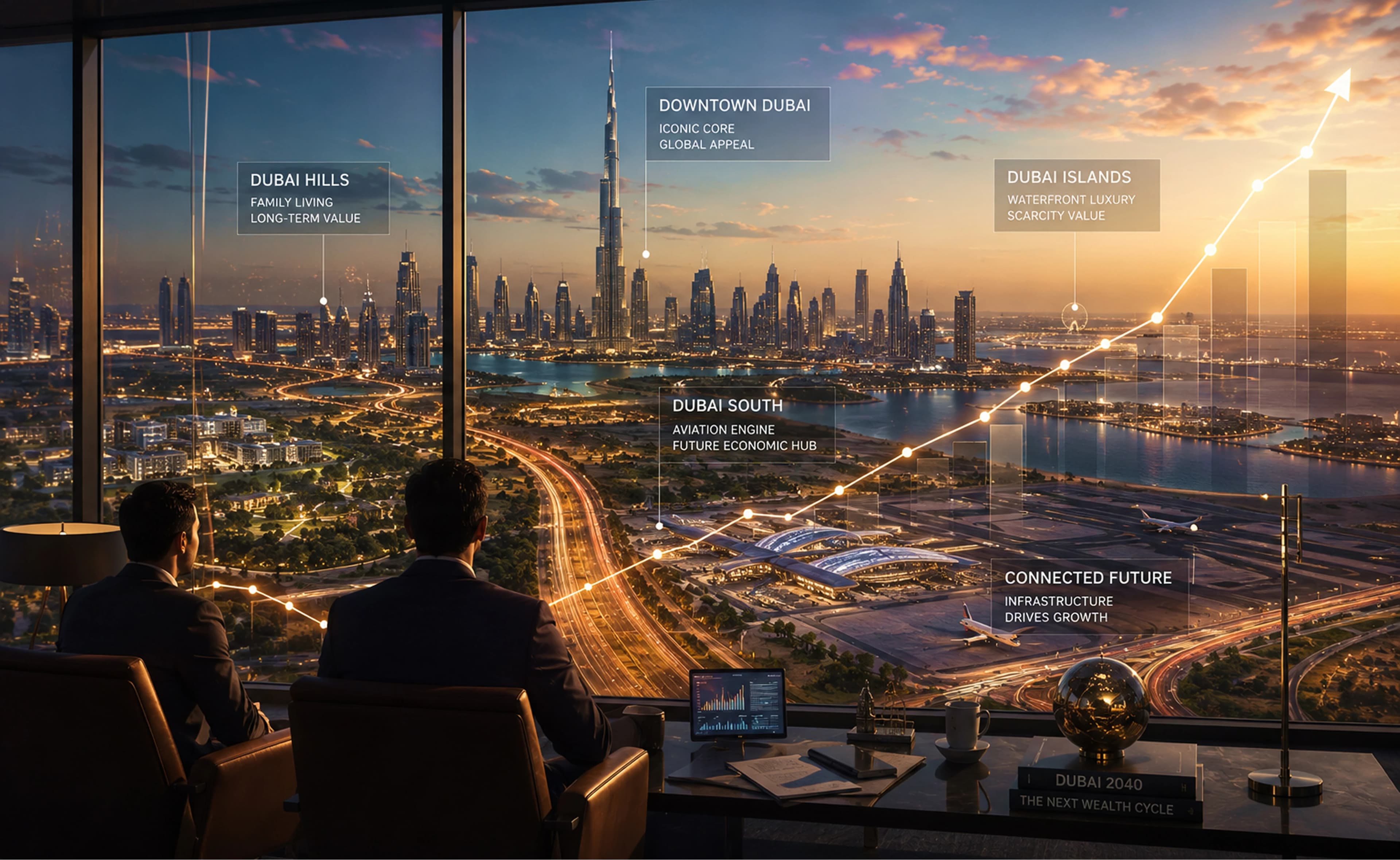
Dubai’s real estate market may be stabilizing, but experienced investors are still seeing massive returns. Discover why infrastructure, end-user demand, and strategic buying are driving the next wealth cycle in Dubai property.